Pass the Gravy, Not the Judgement: Calm Conversations About Therapy with Sceptical Relatives
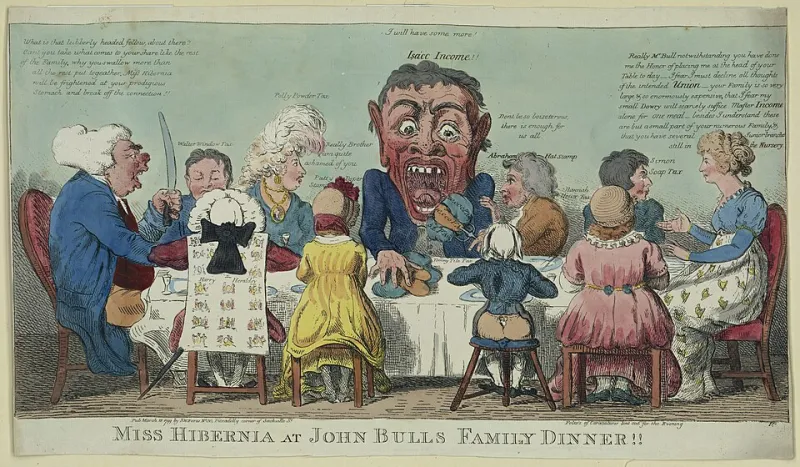
Photo: British Cartoon Prints Collection, Public domain, via Wikimedia Commons
You are at a family dinner. Someone asks what you have been up to. You mention therapy — maybe casually, maybe because it slipped out — and an eyebrow rises. 'Therapy? What do you need that for?' Or, 'In my day, we just got on with it.' Suddenly the roast potatoes are very interesting.
These moments are common. They are also awkward. And while it would be lovely if every relative responded with a warm, well-informed nod, that is not always the family we have. The aim here is not to win the argument. It is to keep your own peace, stay reasonably connected, and avoid spending your evening defending a choice that is yours.
Why the eyebrow goes up
It helps to remember that scepticism is often not really about you. Many older relatives grew up with a stiff-upper-lip message: keep it in the family, do not make a fuss, and certainly do not tell a stranger your business. Some come from cultures or communities where therapy was never discussed, or where asking for help felt like admitting failure. Others have had their own difficult experiences with health services and are wary for good reason.
None of that means you have to agree with them. It just means the resistance may be fear, habit or loyalty to an old way of coping rather than a considered opinion about your life. You can hold that gently and still say, 'This is what I am doing.'
Decide what the conversation is for
Before you go to the gathering, or before the topic comes up, ask yourself what you actually want from the exchange. Do you want to be fully understood? Do you want to be left alone? Do you want to share a little and then move on?
You do not owe anyone a full case file. You can offer a headline rather than the whole chapter. 'I'm seeing someone about stress. It's practical, a bit like physio for the head.' That sort of line gives enough information to satisfy polite curiosity without inviting a referendum.
Scripts for the awkward moment
Keep a few phrases in your pocket. They do not have to be perfect. They just have to be yours.
- For 'What do you need therapy for?' — 'It helps me manage stress and understand my patterns. I'd rather not go into the details tonight.'
- For 'Isn't that for people with serious problems?' — 'Therapy is for ordinary people dealing with ordinary hard things. You don't have to be at rock bottom to benefit.'
- For 'In my day, we just got on with it.' — 'I know you got through things differently. I'm glad you did. This is what I need now.'
- For 'Just think positive.' — 'I wish it were that simple. I'm learning tools that help me do more than just push through.'
- For 'You shouldn't air your business.' — 'I understand that's how you see it. I'm comfortable with what I've chosen.'
- For repeated questioning. — 'I'm not asking you to agree — just to let me have my own approach.'
- For the moment you need out. — 'Can we park this? I'd rather talk about something else. Pass the gravy?'
Notice that none of these scripts try to prove the other person wrong. They simply state your position and, where needed, close the door politely. That is usually more effective than a lecture on neuroscience at the dinner table.
When to stop explaining
If you notice yourself repeating the same point for the third time, or your jaw is tightening, that is a sign to step away. Explanation is not the same as persuasion, and persuasion is not the same as connection. You can say, 'I'm going to get some air,' or 'Let's agree to disagree on this one.' You can also change the subject with deliberate cheerfulness: 'Anyway, how is the garden?'
If a relative keeps mocking therapy after you have asked them to stop, you are allowed to limit the topic. 'I'm not going to talk about this with you, but I'm happy to talk about other things.' That is not a dramatic cut-off. It is a small fence.
Protect your peace afterwards
Family comments can linger longer than the meal. If you leave feeling raw, try not to replay the whole argument in your head. Ring a friend who gets it, write down the one line you wish you had said, and then let it be. You can also decide in advance how much you will share at the next gathering. Some people find it easier to say, 'I'm doing okay,' and leave it there.
It is worth remembering that people can surprise you. A sceptical aunt may never become a therapy advocate, but she might quietly ask how you are doing in her own way. Change is often slow and sideways. You are not responsible for educating everyone.
A gentler bottom line
The name Namaste is often translated as a respectful greeting — a recognition of the other person. You can offer that recognition even when you disagree. Your relative does not have to understand your therapy for it to be worthwhile. You do not have to convert anyone at the table. Sometimes the most mindful move is to pass the gravy, keep your boundary, and let the conversation move on.